
Compare Harlan County Property Value Types
A Harlan County property value can mean an assessment figure, a fair-cash estimate, sale consideration in a deed, or a private appraisal. Each answers a different question.
| Value | What It Is | Where |
|---|---|---|
| Assessed value | PVA figure used in taxation | Parcel card |
| Fair cash value | Estimated voluntary-sale value | Kentucky assessment standard |
| Last sale price | Consideration, if stated | Recorded deed image |
| Land vs improvement | Components when shown | PVA parcel card |
Assessment timing, property condition, exemptions, sale circumstances, and market movement can all pull those figures apart. The parcel card publishes no last-sale field, so no sale price should be read into it.
Apply Kentucky's Harlan County Fair-Cash Standard
Kentucky defines fair cash value as the price real property would bring in a fair voluntary sale. The PVA can value land through sales, cost, or income approaches. Qualifying agricultural land follows a separate use-value rule. Its taxable figure should not be compared casually with an ordinary home sale. Harlan publishes no county-specific assessment ratio. Neither is a broad local revaluation date posted. That gap matters. Use the value and tax year printed on the live parcel card rather than an unsupported local ratio. The Department of Revenue assessment page explains the standard.
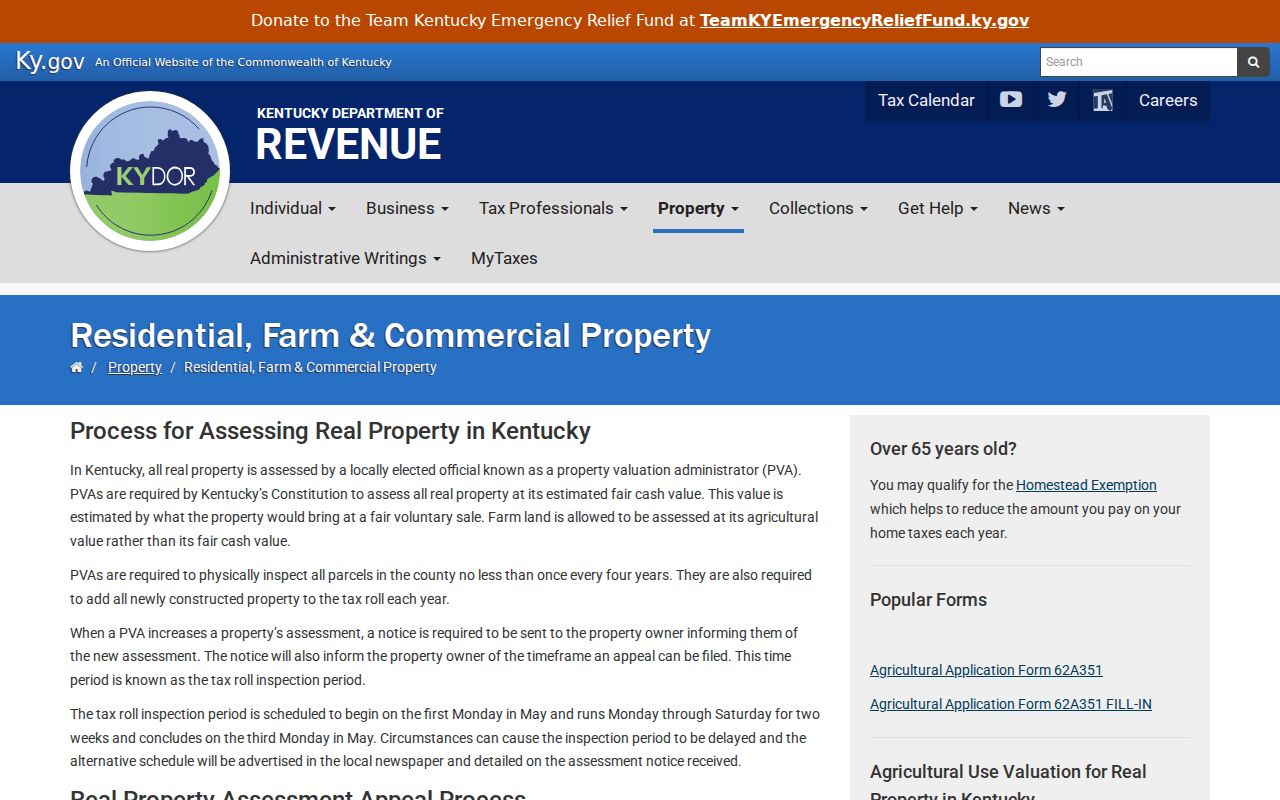
State guidance sets the framework. Each Harlan PVA parcel card supplies the account-specific number.
Read Harlan County's Parcel Value Fields
A Harlan parcel card carries the parcel and account identifiers, owner, mailing and situs addresses, description, class, tax district, land characteristics, and valuation history. Those fields tie the value to one tract. They also pin the roll entry behind the figure. That matters in a county where two parcels can share a similar road name and still be entirely different property.
| Parcel and account | Cross-reference keys for the assessment record |
|---|---|
| Class and tax district | Administrative context for the assessed tract |
| Land characteristics | Recorded facts that may inform valuation |
| Value history | Prior roll figures and their dates when shown |
One sample Harlan record listed Residential class, 04 Graded, rolling topography, no listed flood hazard, and Secondary road access. Those are single-record examples. They describe one parcel, not every Harlan tract.
Note: Copy the parcel number and value year with every figure so the Harlan County property value stays tied to its source.
Place Harlan County Values in the Inspection Cycle
Kentucky allows annual revaluation and requires a physical inspection at least once every four years. Inspection is not the only trigger. New construction, demolition, corrected parcel data, or a review of market evidence can move a value too. Few parcels change on the same four-year date.
The tax roll opens for inspection on the first Monday in May and closes after a two-week period ending the third Monday. That window is the taxpayer's review period. Appeal steps belong with the property-tax records. The valuation figures themselves are what this calendar tracks.
The January 1 assessment date adds another marker. A later sale can be recorded while the annual tax record still reflects the earlier ownership snapshot. The older value is not wrong. It simply belongs to an earlier date. Compare dates before linking the roll figure to a new transfer.
Estimate Harlan County Value From Official Records
Start at the Harlan County PVA qPublic entry. The search accepts owner name, location address, parcel number, and legal information. Each mode returns the same parcel card. If a direct search URL fails, the PVA landing page is the dependable way in.
- Find the correct parcel by its physical address and APN.
- Record the land, improvement, total, and value-history fields that actually appear.
- Write down the tax year or upload date associated with the result.
- Inspect the newest deed separately for consideration or transfer-tax language.
- Compare dates and legal descriptions before comparing the numbers.
Assessed value is the PVA figure used in taxation. Fair cash value is Kentucky's voluntary-sale estimate. Sale consideration is deed language, while reassessment is a later official review of the roll figure.
The PVA search returns an assessment record, not a private price forecast. A blank value field stays blank. Never fill it with another parcel's number or a generic county average.
Compare Harlan Assessment With Recorded Sale Price
A deed image can show consideration or transfer-tax language even when the parcel card displays no last-sale field. Use the Harlan County Clerk records route to locate the matched conveyance. The clerk records county conveyances. No separate register of deeds exists in Harlan.
A recorded price is not automatically market value. Family transfers, estate conveyances, gifts, nominal consideration, fiduciary deeds, and partial interests can all produce amounts far from an arm's-length sale. Confirm the instrument covers the entire subject parcel. Determine what kind of transfer occurred as well.
A sound comparison also asks whether the deed bundled several tracts, conveyed mineral rights separately, or moved only part of an interest. Harlan land descriptions lean on road, watercourse, acreage, plat, lot-and-block, or metes-and-bounds clues. Those details keep the sale evidence tied to the same real estate valued on the PVA card.
Private citizens get five online searches per day. Courthouse visits, office contact, and mail requests are the fallback channels. A Kentucky Open Records Act request works too.
Keep Exemptions Apart From Harlan Property Value
An exemption lowers the taxable figure. It does not change the fair cash value behind it. So a smaller taxable number can appear on a Harlan tax bill. It never proves the real estate lost worth. The PVA's parcel cards may not spell out every exemption either. Fields on a live result can vary by account. Ask the Harlan PVA about any exemption on a specific account. When comparing valuations, keep assessed, taxable, and exempt amounts separate. Label each one exactly as the record does. Never blend them into a single estimate of what the property is worth.
Use Harlan Historic Context Without Inflating Value
Historic material explains setting, not price. Old maps and district records can reveal when a building went up or how a neighborhood formed. None of that is an appraisal. The Library of Congress holds Harlan and Harlan County Sanborn sheets covering 1932 through 1947. The National Park Service listing for Cumberland's central business district cites a period of significance. It runs from 1911 to 1930.
These sources can pinpoint a former building footprint or a street's earlier character. They cannot prove a parcel sits in a current overlay. They cannot show it earns an incentive or deserves a higher sale price. Always match a historic boundary or structure to the modern parcel number before concluding anything.
Local geography calls for the same restraint. Road access, rolling terrain, flood data, utilities, and improvements all shape value. Yet a field noted on one Harlan parcel card cannot be assumed for the tract next door. Read each parcel's own card. Confirm deed and map context before comparing one tract with another.
Note: Historic context enriches Harlan County property value research. It is neither title evidence nor a valuation adjustment.
Know What Harlan County Property Value Cannot Prove
An assessment is a mass-appraisal figure for the tax system. It cannot promise a sale price. It cannot establish current condition the PVA has not seen. Nor can it settle a boundary or ownership dispute. And it cannot stand in for an appraisal built around one transaction. Nor can it account for every renovation, deferred repair, easement, access problem, or private agreement a careful review of the transaction might surface.
Value is not price. Harlan County assessed value is not a promise of what a property would sell for and is not a private appraisal.
Treat the official numbers as a documented baseline. Add current condition, comparable arm's-length sales, and qualified appraisal work as the situation demands. For bills, exemptions, and appeal steps, see the Harlan County property tax records guide.